

Product description
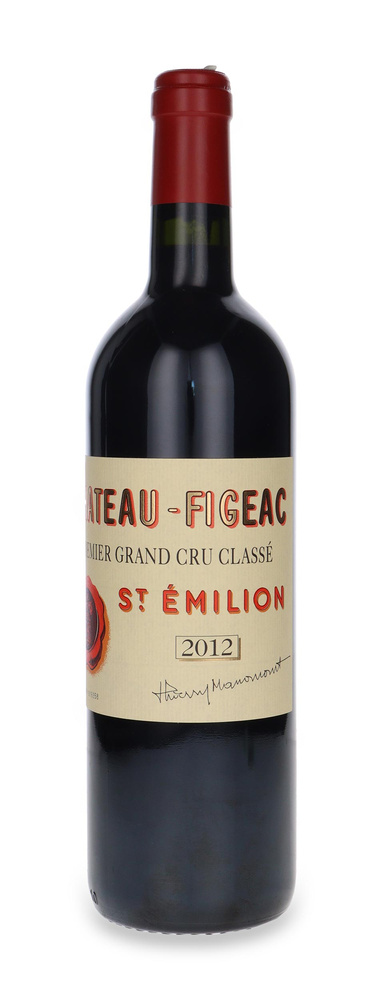
Château Figeac is one of the most distinctive estates in Saint-Émilion—as old as winemaking itself on the right bank.Its history dates back to Roman times: it was named after the villa’s owner, Figeacus, and subsequent generations have cultivated grapes here almost continuously for two millennia.Today’s Figeac stands out for its terroir—three gravelly, Guntian-era ridges containing flint and quartz over a bed of blue clay—which gives the Cabernet varieties an advantage rarely found in Saint-Émilion.That's why the wine is sometimes described as “Medoc-style,” even though it’s produced on the right bank of the Dordogne.In 2012, the estate held Premier Grand Cru Classé (B) status in the Saint-Émilion classification (promoted to Class A in 2022), and its vineyards form a single, cohesive estate covering a significant area, planted with Cabernet Sauvignon, Cabernet Franc, and Merlot, all well-suited to this gravelly landscape.
The vineyard itself is a rarity in the appellation: it is dominated by three gravelly hills with excellent drainage and heat-retaining stones, allowing the Cabernets to ripen fully—imparting structure, vibrancy, and a mineral character—while the Merlot contributes softness and charm.It is precisely this geology and the cool, northwest-facing slopes that create a mosaic of microclimates, which Figeac draws upon in its blending; for generations, the blend here has been atypical for Saint-Émilion: two-thirds Cabernet versus one-third Merlot—a ratio that defines the estate’s style.
An interesting fact is that Figeac, although it neighbors Cheval Blanc, often resembles wines from the Médoc and Graves in style—a result of the Guntian gravels, which are rare in this part of the Right Bank.It is also one of the largest estates in Saint-Émilion that has been continuously cultivated throughout history, which further reinforces its identity and stylistic continuity.
The 2012 vintage has gone down in the estate's history as a wine with a classic, taut structure and exceptional fruit purity.This year's blend is pretty good.40% Merlot, 40% Cabernet Sauvignon, and 20% Cabernet Franc—a reversal of the proportions typical for the appellation.The wine aged for about.15–18 months in 100% new French oak barrels, which added depth and refined spiciness without overshadowing the character of the terroir.
Appearance: deep ruby red with garnet highlights at the rim, clear and dense in the glass.
Aroma: ripe black currant and blackberry, Hungarian plum, cedar and pencil, notes of graphite, violet, and black currant leaves; in the background, truffle, tobacco, pepper, and delicate vanilla from a new barrel.
Taste: medium-plus to full-bodied, with supple, fine-grained tannins and a chalky texture, juicy acidity; a core of black fruit carried by a mineral pulse and length; a cedar-and-earthy finish, with hints of cocoa and herbs.
Dining Pairings: sirloin steak or entrecôte from a cast-iron skillet, roasted duck with black currant sauce, venison tenderloin with porcini mushrooms, aged cow’s milk cheeses (Comté, Cantal), and in Polish cuisine—venison goulash or roast goose with marjoram.(A selection inspired by Cabernet varieties and the classic Saint-Émilion style.)