

Product description
Château d’Yquem is not just a vineyard—it’s a story about a place where the autumn mists rising from the Ciron and Garonne rivers envelop the hills of Sauternes, creating the conditions for the miracle of botrytis.At the top of this hilly terroir, on gravel mixed with clay and limestone, there are approximately 113 hectares of vines (typically ~100 hectares under production), planted mainly with Sémillon and a small amount of Sauvignon Blanc.It is here, thanks to meticulous harvests carried out over multiple passes and microscopic yields of just a few hectoliters per hectare—there is even talk of “a single glass from a single vine”— —that the only wine in the history of the Bordeaux classification (1855) to be ranked Premier Cru Supérieur is produced.Now owned by LVMH, the estate upholds the legacy of the Lur-Saluces family and its famously rigorous selection process: in weaker vintages, Yquem may choose not to bottle the wine (as in 2012) so as not to compromise the legacy of the legend..
The year 2014 in Sauternes brought a long, painstaking harvest—at Yquem, it lasted about nine weeks, with roughly one-quarter of the grapes having been placed in vats by September 15.This is a vintage in which precise acidity meets creamy sweetness, and the fruit's vibrancy enhances the wine's longevity.After barrel fermentation, all the barrels are aged for 6–8 months, followed by a rigorous selection process; only the best are sent to the cellar for another ~20 months of aging (Yquem traditionally uses 100% new French oak barrels).In practice, this means about two and a half years of aging in wood before the wine is bottled.
The facts that best illustrate the scale of the effort are the number of harvest passes through the vineyard (several “tries,” from September through November) and the legendary low yields — Yquem consistently yields around 8–10 hl/ha, which explains both the price and the timeless concentration in the glass.
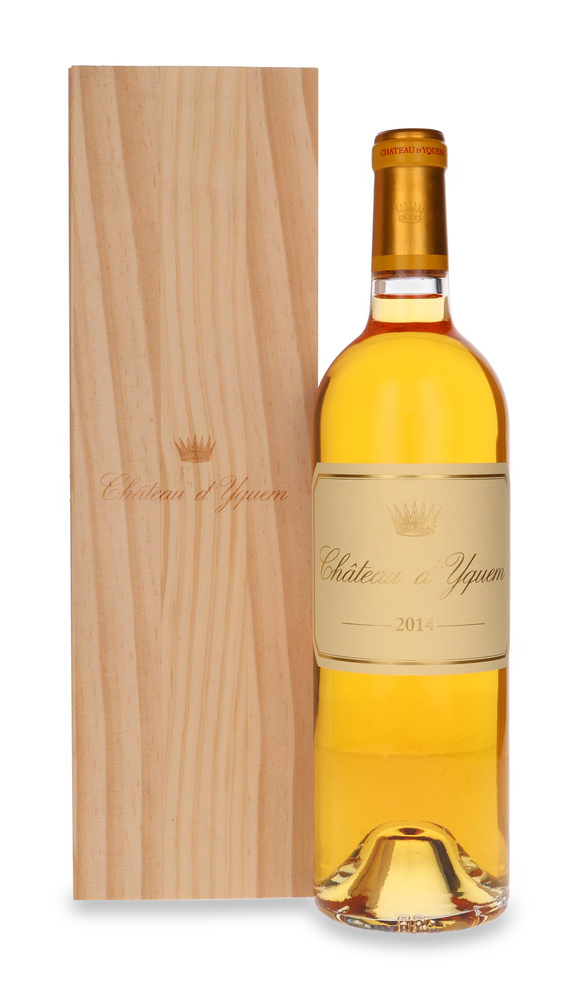
Appearance: a deep, shimmering straw-gold color, thick legs, and a viscous texture that hints at richness.
Aroma: honeycomb, candied citrus peel, apricot and peach, jasmine and acacia; over time, notes of saffron, white chocolate, and almond emerge.
Taste: creamy, silky sweetness counterbalanced by a crisp edge; notes of pineapple, mandarin, peach, and honey with a long, luminous, almond-citrus finish.
Food pairings: classically with foie gras and aged, salty cheeses (Roquefort), but also with Asian cuisine featuring a sweet-and-spicy profile (Peking duck, Thai curry), butter-poached lobster, an apricot tart, or a simple tarte Tatin—thanks to its freshness, the 2014 vintage will pair beautifully with both savory dishes and fruit desserts.