

Product description
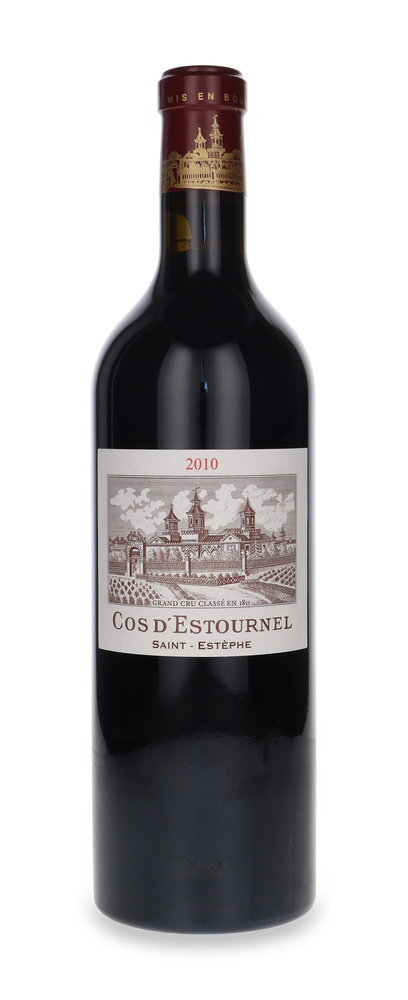
Château Cos d’Estournel is one of the most recognizable estates on the left bank of Bordeaux—“the hill of pebbles” (from the Gascon word “cos” ) right on the border with Pauillac, overlooking the Gironde.Its splendor lies not only in its 1855 Deuxième Cru Classé status, but also in the oriental pagodas and elephants—the hallmark of owner Michel Reybier—which reflect the fascination of the estate’s founder, Louis-Gaspard d’Estournel, with trade with India.Hence the nickname “the Maharaja of Saint-Estèphe” and the architecture, whose exotic character contrasts with the cool elegance of the gravelly soils.Today's winery uses a gravity-fed system, which allows for exceptionally gentle extraction and a clean, crisp style.
The estate’s history begins in 1811 and quickly becomes the stuff of legend: the wine was even shipped as far as Bombay and Calcutta, and some batches made their way back to Europe as “returned from India” —a story that contributes to the myth and explains the origin of the pagodas and the elephant motif on the label and in the gardens.Today, the vineyards (approx..(91 ha) surround the château, and mature Cabernet Sauvignon vines dominate the gravelly peaks, while Merlot thrives best on the slopes with outcrops of Saint-Estèphe limestone.
One interesting detail that catches your eye as soon as you drive in is the contrast: the oriental façade conceals one of the most modern, fully gravity-fed cellars in Bordeaux (implemented in 2008).This blend of tradition and innovation is the essence of Cos d’Estournel: the romance of a journey to India meets French precision in winemaking.
The 2010 vintage is considered here to be the epitome of balance between power and finesse.The official technical sheet lists the blend as follows: 78% Cabernet Sauvignon, 19% Merlot, 2% Cabernet Franc, and 1% Petit Verdot; alcohol content 14.5%.The wine aged for about.18 months, the vast majority of which was spent in new French oak barrels—80% of the barrels in this vintage were new (various sources cite 70–80% new barrels, but the consensus remains 18 months and approx..four-fifths of new oak).
Appearance: deep, rich ruby with purple highlights, opaque at the rim of the glass; thick, slow tears indicating concentration.
Aroma: black currant and blackberry open the bouquet, followed by graphite, pencil, tobacco leaf, and licorice; over time, juniper, pepper, ink, delicate vanilla, and freshly shaved cedar from the barrel emerge.
Taste: powerful yet lively; the core of fruit is carried by fine-grained, chalky tannins and the vibrant, “cool” acidity of the 2010 vintage; a very long finish with recurring notes of currant, black tea, and a hint of graphite and minerality.
Food pairings: Left Bank classics: beef entrecôte or roast beef, lamb with rosemary, game (venison loin), pepper steak; in the French style— entrecôte à la bordelaise , and with aged cheeses—Comté (24–30 months) or hard tomme.