

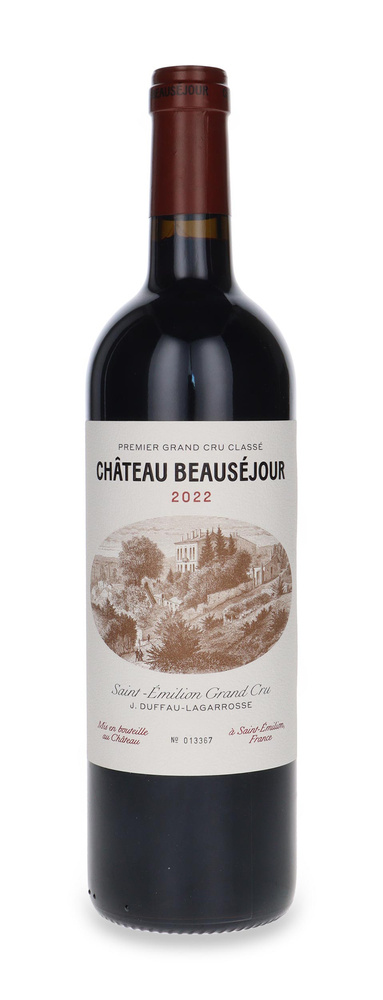
Chateau Beausejour Saint-Emilion Grand Cru 2022 / 14.5% / 0.75 L
- Château Beauséjour (Héritiers Duffau-Lagarrosse) 2022 is a vintage in which Joséphine Duffau-Lagarrosse’s new philosophy meets the legendary limestone of Saint-Émilion, resulting in a wine of rare purity and tension. It has the potential to age for many y
Product description
It comes from one of the most picturesque corners of the limestone plateau of Saint-Émilion: a tiny, ~7-hectare Château Beauséjour (Héritiers Duffau-Lagarrosse), which has been among the Premiers Grands Crus Classés since 1955.The vineyard owes its current layout to the 19th-century division of the former estate into two parts (the other half is today’s Beau-Séjour Bécot) —and since then, Beauséjour Duffau-Lagarrosse has been building a reputation for red wines with chalky vibrancy and longevity.In 2021, Joséphine Duffau-Lagarrosse (together with the Courtin-Clarins family) took the helm, ushering in a new chapter: more finesse, a greater emphasis on Cabernet Franc, and an even more precise expression of the limestone terroir.Her first “A to Z” vintage is 2022, and it was crafted with the new cellar and a longer, more refined élevage in mind.
It is a vineyard-garden anchored directly into solid rock, with vines reaching deep into the cracks in the limestone; it is just a few steps away from its neighbors, Canon and Angélus.Small scale (approx..(6.8–7 ha) and the contiguous block of plots on the hillside mean that the vintages here are surprisingly consistent, and the style is imbued with a “chalky” character.Beauséjour also produces a second wine, Croix de Beauséjour, but it is the grand vin that defines the estate: in 2022, the harvest began on September 6–9 for Merlot and on September 23 for Cabernet Franc; the yield was approximately.42 hl/ha, 14.5–14.9% alcohol, and a low pH of ~3.45–3.50—all of which result in a wine that is dense, yet taut and fresh.
The 2022 vintage embodies the essence of the “new” Beauséjour: a blend of 69% Merlot and 31% Cabernet Franc—the highest proportion of Franc in the wine’s history—and aging for approximately.18 months in ~70% new French oak barrels (the rest used once), extended m.in.due to work on the new basement.Critics have showered it with outstanding ratings: James Suckling 97–98/100, Jeb Dunnuck 98+ (February 2025), Wine Advocate 95–97+; many commentators highlight its “chalky” energy, long, salty finish, and exceptionally fine tannins.
Appearance: a deep, opaque purple with ink-like highlights at the rim; dense legs slowly trickling down the glass.
Aroma: black cherry and blackberry with hints of violet petals and dried roses; followed by licorice, cedar, and subtle spice notes; as it opens up, it reveals cool chalky dust and crushed rock.
Taste: a silky fruit attack (cherry, black currant) is immediately permeated by a lime-like liveliness; ultra-refined, chalky tannins lead to a very long, “salty” finish; excellent balance between ripeness and freshness.
Culinary Pairings: classic dishes and grilled specialties: entrecôte with roasted shallots, leg of lamb with herbs, beef cheeks braised in red wine; from Polish cuisine—roasted goose with marjoram or pikeperch in butter with porcini mushrooms (a contrast of textures and umami); cheeses: 18–24-month-aged Comté, Cantal, aged Tome.