

Product description
History of the Winery Château Margaux is an almost mythical tale, rooted in the finest terroir of the Médoc region in Bordeaux, steeped in prestige and sophistication.Located in the Margaux appellation—on the left bank of the Gironde estuary—this winery traces its roots back to at least the 15th century, although the name “Château Margaux” itself did not come into use in its modern sense until later.
Early records refer to a knight's estate known as “La Mothe de Margaux” or “Lamothe-Margaux,” whose lands were gradually converted into vineyards.In the 17th century, the owner, Olive de Lestonnac, significantly expanded the estate, and over time, the wines produced there began to garner admiration beyond France—even from the American ambassador to Paris, Thomas Jefferson.
A pivotal moment occurred in the second half of the 19th century: in 1855, the Hungarian classification of Bordeaux awarded Château Margaux the status of Premier Grand Cru Classé —one of the five highest categories—which only underscored the importance of this winery.In the 20th century, however, difficult times arose—the phylloxera epidemic, economic crises, and neglect on the part of the owners.In the early 1970s.In the 20th century, the vineyard found itself in serious trouble.
The revival began in 1977 when Greek businessman André Mentzelopoulos took over the estate and invested in the revitalization of the vineyards, cellars, and infrastructure—it was he who ushered in a new era for Château Margaux.After his death, his daughter, Corinne Mentzelopoulos, took over management and continued the modernization while respecting tradition.
Geographically and agronomically, the Château Margaux vineyard is unique.The wine comes from plots located on gravel ridges that formed during the Pleistocene—a layer of gravel up to 4–11 meters deep provides excellent drainage and exceptional conditions for the vine roots. The high proportion of Cabernet Sauvignon in the vineyards—typically around 75%—is particularly important, as it gives the wines structure and longevity.
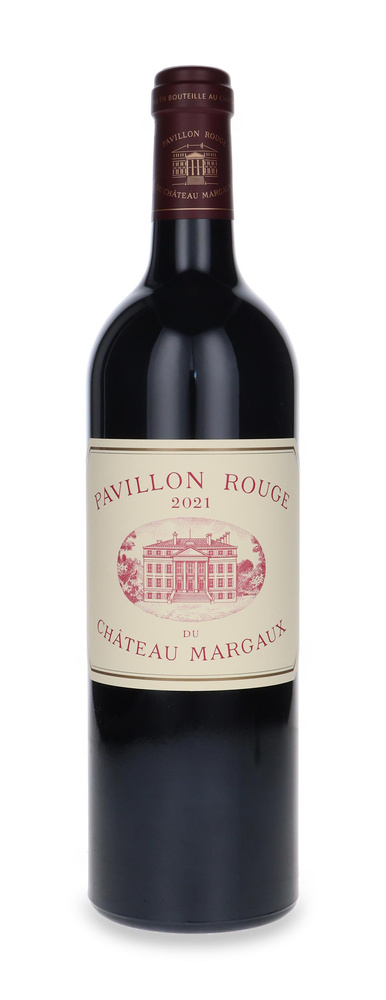
As for the second wine we’re discussing — Pavillon Rouge du Château Margaux — the estate applies the same selection philosophy: although it is not the main wine, it receives a significant portion of the same attention as the “Grand Vin”.The winery emphasizes that, over the years, the quality of Pavillon Rouge has increasingly matched that of the first wine.
An interesting fact is that Château Margaux’s second wine adopted its permanent name, “Pavillon Rouge,” in 1908. Another factor is that in later decades, when the vineyard’s quality declined, production was suspended or scaled back—for example, during the period between the 1930s.and 70.In the 20th century, the Pavillon Rouge was virtually nonexistent until its renovation in 1977.Yet another point—it was said that in some years the distinction between the “first” and “second” wines at this vineyard became almost imperceptible, which is exceptional in the world of Bordeaux wines.
Pavillon Rouge du Château Margaux 2021 is the second wine from one of Bordeaux’s most famous and prestigious estates, produced from the same vineyard as the Grand Vin.It combines the elegance and style characteristic of Margaux, while offering a more approachable character and earlier drinkability.This bottle perfectly captures the spirit of Château Margaux and serves as an ideal introduction to the world of this terroir's great wines.
Appearance: a deep ruby-purple color, with youthful intensity and slightly navy-blue highlights at the rim; clear, with a beautiful sheen.
Aroma: dominant notes of black currant, plum, and cherry, transitioning into raspberry and violets; in the background, cedar, graphite, tobacco, and subtle spicy and herbal notes emerge.
Taste: medium-bodied, with an elegant balance between juicy fruit and silky, fine-grained tannins; fresh, invigorating acidity lends lightness and structure; a long, harmonious finish with mineral and fruity notes.
Food pairings: perfect with roast lamb with rosemary and garlic, venison in a red wine and fruit sauce, and a classic roast beef steak; it pairs wonderfully with Mediterranean dishes featuring eggplant and mushrooms, as well as with aged hard cheeses such as Comté, Gruyère, or vintage cheddar.