


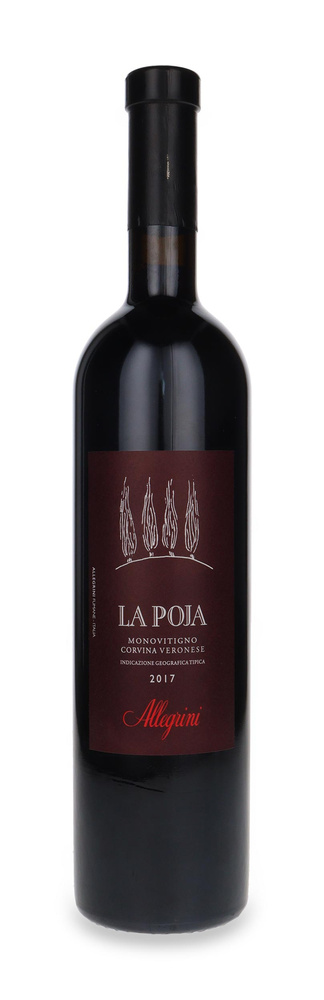
Allegrini La Poja Monovitigno Corvina Veronese 2017 / 14.5% / 0.75 L
- Allegrini La Poja 2017 is a deep ruby-red, elegant wine that captures the very essence of the Corvina grape, blending aromas of black fruit, cedar, and spices with the mineral freshness of the limestone soil of La Groli. Full-bodied and silky on the palat
Product description
In the heart of Valpolicella Classica, between Fumane and Sant’Ambrogio, stands the name Allegrini—a family of winemakers that has been weaving the history of this region since the 16th century.The estate’s current appearance is the legacy of Giovanni Allegrini, a visionary who, in the 1970s,.In the 20th century, he revitalized the local hills by focusing on dense plantings, the Guyot method, and uncompromising quality.Today, his children and grandchildren carry on this legacy, preserving a style that balances power and finesse while boldly experimenting with their native Corvina.
La Poja—a single-vineyard wine from the very top of the famous La Grola hill—grew out of this family ethos.It is a triangular plateau surrounded by cypress trees, with "white" limestone soil, offering a view of nearby Lake Garda.Giovanni planted it at Corvina in 1979, convinced that this was the place where this grape variety would reveal its purest, most noble character.La Poja was one of the region’s pioneering expressions of the “single-vineyard” concept, and its stony, humus-poor soil and airy exposure lend the wine a mineral liveliness and gravitas.The name itself has two possible etymologies: either from “Pojany”—a buzzard circling above the hilltop—or from a Lombard word meaning “farmland,” which beautifully combines nature with the history of human labor.
La Poja is also a manifestation of the Allegrini style: a great Corvina wine made without the traditional Amarone process of drying the grapes (appassimento).The grapes are harvested late, during the final phase of the harvest, to capture full phenolic ripeness; the wine then ages for a long time—first for about 20 months in new Allier oak barriques, followed by 8 months in large Slavonian oak barrels and nearly 10 more months in the bottle.This long, multi-layered aging process serves here as a tool for shaping the structure, rather than as an aromatic mask—the oak enhances the clarity of the fruit and the contours of the tannins.
Appearance: a deep ruby-navy color with ink-like reflections at the rim, dense and lustrous, revealing the wine’s concentration and youth.
Aroma: ripe black fruits—blackberry, black currant, cherry—intertwine with notes of cedar, toasted hazelnuts, spicy herbs, and balsamic herbs (sage, bay leaf, juniper) and a delicate hint of licorice.
Taste: full-bodied, intense, yet silky and harmonious; a core of black fruit drives the structure, fine-grained tannins lend elegance, and the finish is long, with notes of pepper, licorice, and a mineral, chalky backdrop.
Food pairings: entrecôte or beef tenderloin steak, lamb with rosemary, venison loin in mushroom sauce, roasted duck with cherries and juniper; risotto with porcini mushrooms or black pepper, polenta with Monte Veronese, aged Parmigiano Reggiano, and in the fall, dishes with truffles and roasted root vegetables.