


Product description
There is a winery in Bolgheri that has revolutionized Tuscany—Tenuta San Guido.Its history begins with the vision of Marquis Mario Incisa della Rocchetta, who, after the war, planted Cabernet Sauvignon and Cabernet Franc on gravelly, stony plots, inspired by the gravel soils of Graves in Bordeaux.For over two decades, the wine remained a family secret; the first vintage of Sassicaia did not reach the market until 1968, and it quickly became an icon, while the estate itself became the benchmark for the entire “Super Tuscan” category.Today, Tenuta San Guido cultivates grapevines across a mosaic of habitats ranging from 100 to 360 m a.s.l..p.m., where the soil is full of marl, stones, and pebbles—which is, in fact, where the name Sassicaia comes from, meaning “stony place”.It is this terroir—diverse and airy—that gives the wines their liveliness and mineral character, which has long been the hallmark of this estate.
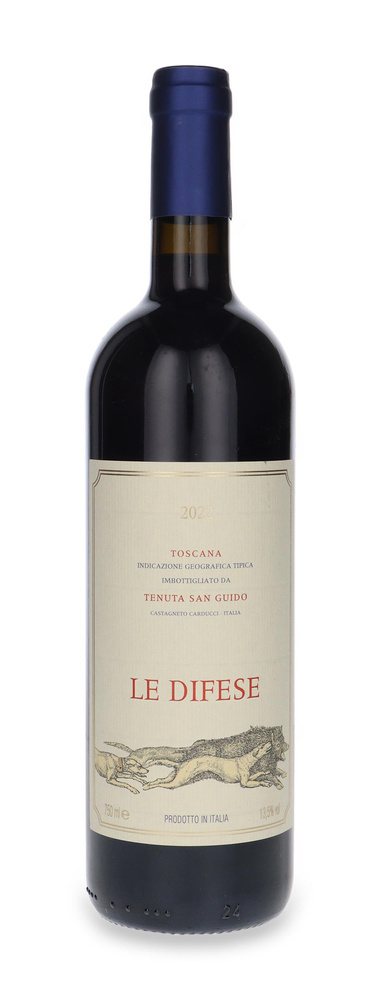
Although the legend was built around Sassicaia, Tenuta San Guido’s winemaking story has three acts: Guidalberto (2000) and Le Difese (2002) were added to the portfolio—each with its own character, but sharing the estate’s signature elegance.Le Difese features golden boar tusks on its label, and that’s where it gets its name: “le difese” means “tusks” and “defense” in Italian—a nod to the Tuscan forests, where wild boars have always been a part of the vineyards.This label evokes more of Tuscany than rebellion; it’s a wine meant to showcase the estate’s style in a more accessible, casual way.
For Le Difese, the 2022 vintage was a year of challenges and a smaller harvest, but also one in which the fruit from the cooler, higher-altitude plots reached beautiful ripeness.This wine was made from the classic blend of Sangiovese and Cabernet Sauvignon typical of this cuvée—in 2022, the proportions were approximately.55% Sangiovese and 45% Cabernet—with the Sangiovese coming from long-standing partner vineyards in Chianti and Chianti Rufina (it’s hard to find this variety planted in Bolgheri itself).The grapes were harvested by hand, and the wine fermented in temperature-controlled stainless steel tanks, with maceration lasting about 12 days for Sangiovese and slightly longer for Cabernet.Effect?A wine with intense, juicy fruit, a soft texture, and silky, well-integrated tannins.
Appearance: A ruby-red, clear color with a cherry-red sheen, bright and sparkling in the glass: the wine looks fresh and elegant, promising a juicy character.
Aroma: An intense bouquet of red cherries, sweet cherries, and pomegranate, complemented by notes of blood orange, dried herbs, leather, and a subtle minerality.
Taste: Medium-bodied on the palate, juicy and lively, with ripe tannins and fresh acidity; a long, fruity-mineral finish with a hint of spice.
Food pairings: Perfect with bistecca alla fiorentina, herb-roasted chicken, or pasta with game; it also pairs wonderfully with pizza, aged cheeses, and grilled tuna.